Wednesday, May 23, 2012

Week 9

If you're in my quiz section (AE) with Monica tomorrow at 11:30am, here's a heads up/sneak peek on what Elena, Andrew and I will be discussing. And even if you're not, think of this as a little study guide for week 9 readings and concepts (useful for studying for the final exam!)


Rosin, Elena, and Andrew – GEOG 271 AE – Week 9 Discussion Questions

FOOD SOVEREIGNTY QUESTIONS (Elena)
• Make a multi-dimensional definition of food sovereignty.
• What are the root causes of hunger and malnutrition? How do these causes play into the history
of food sovereignty? (hint: think about the shift away from food security)
• What is hegemony and how does it play a role in the food sector?
• Describe how issues with Brazil's economic and political structure have historically created
hunger.
• What factors need to be addressed to ensure food sovereignty for developing nations such as
Brazil?
• Which structural policies suggested by Stedile and Carvalho seem most feasible and changeable
from your perspective?

FOOD JUSTICE QUESTIONS (Rosin)
• What are the similarities and differences between Growing Food and Justice for All Initiative
and the Community Food Security Coalition?
• In which ways does Young Kim and the Hmong Farmers in Wisconsin reflect food justice or
food security, or perhaps both?
• Where do we see and what are examples of racism seen in the current food system?
 How do the food justice movement, the GFJI, Young Kim, and The Rural Enterprise Center (REC) address racism in the food system?


Week 9 Key Concepts
Food sovereignty
Political Ecology
La Via Campesina
Belo Horizonte
Food justice
Growing Power’s Growing Food for All Initiative
Community Food Security Coalition
Indigenous Food Systems
Sustainable Development
Sustainable Agriculture
Alternative Food Networks
Food relocalisation

Check back for our/our quiz sections definitions and answers to discussion questions!

Thursday, May 17, 2012

Community Gardening?

Second assignments are turned so let's take a moment to relax, laugh, and pause before we start studying for the final!

Wednesday, May 16, 2012

The Food Stamp Challenge

Here's a clip of famous chef, Mario Batali, on his show The Chew in which he describes in brief how his family challenged themselves to eat on a food stamp budget.


From Takecharge.com:
As Batali mentions in the clip, the $124 a week for a family of four doesn’t seem like a big deal when you don’t go out to eat, don’t eat processed foods, and have time to cook at home. However, many of the people receiving food stamps in the United States don’t have the luxury of time required to do so. To fit within his budget, Batali had to meal plan, shop at several different stores, and eschew the luxury ingredients he already had at home.
Read the full article here: http://www.takepart.com/video/clip-day-mario-batali-eats-food-stamp-budget
But earlier, in 2010, Take Charge highlighted the same challenge: SNAP Hunger Challenge which is a budget of $4.50 per day.

How is your second assignment on food budgeting going, everyone? What kind of sacrifices is your family making? What is the toughest reality you may be facing in regards to finding affordable, but healthy foods?

"Ditch the compostables"

As we've all learned from class, the Second Agro-Food System began after WWII with the intention of "feeding the world" with high yield crop production. In particular the ubiquitous crop: corn. We know how the story goes, right? The birth of corn as we know it today reads something like: corn subsidies for farmers, high yields, corn surplus, corn-fed animals, and the corn-linked chain goes on.

In an article written by our very own Geography 271-er, Kali Swenson, another use for corn is highlighted: compostable materials. In the words of Kali herself:
How we eat has just as much an impact as what we eat. The compostable utensils and packaging popping up more and more these days, intending to be "green," are less benign than one would expect. Check out how these unexpected offenders affect the food system too.
Read her enlightening article, "Ditch the compostables", featured in UW's The Daily!

"We see the word “compostable” printed next to a green leaf and automatically feel assured that we are helping the environment in some way."


Another take on the PLA (polylactic acid)/corn-based compostable materials issue can be read at the Smithsonian blog. The article, "Corn Plastic to the Rescue" is written by Elizabeth Royte, a resident of Brooklyn, and the author of Garbage Land: On the Secret Trail of Trash. This article sees compostables more as the lesser of two evils.


To me, one thing is clear. Nothing is clear, or one could say, as resolute as one could hope. What I mean is that solutions are never easy, in fact they only seem to become more and more complex. As individuals attempt to resolve environmental issues, whether from top-down (i.e. tech or business fixes, government policy) or bottom-up (i.e. farmer's markets, personal action, small-scale), complications always arise and opinions of what is an 'ideal' or 'perfect' answer generally conflict. My personal philosophy is to do what you can, the best you can. Don't let compostable materials be manufactured in vain-- make the few extra steps to dispose of it correctly. And when possible, avoid relying on them at all, because what petroleum-based and corn-based compostables have in common is the capitalistic ideology associated with them. That is to say we are conceived as a population of consumers and are treated as such. These things are made because it is known (assumed) that we will use them. A great way to reduce environmental impact is to "simply" consume less.

Sunday, May 13, 2012

Your voice!

Don't forget, fellow Geography of Food & Eating classmates, that you can write posts of your own and be a blog contributor! If you have a topic or food issue that you're interested in or passionate about (be it the tomato industry and farmer justice, or GEO/GMO policy, or bee keeping) well then, I want to hear from you! I want as many voices to be represented on this blog and that's where your voice comes in. I encourage you to document your discoveries--maybe you've sworn off meat now, or perhaps you're more prone choose meat not produced on CAFOs--and if you feel so inclined, do share them here! 


Feel free to e-mail potential blog posts at rosinsaez@gmail.com 


Can't wait to hear from you!


Here's some positive and simple steps to take "to change our food system". Although we all know it's more complicated than this, I think small actions that strive to make change in the right direction are never in vain.

Monday, May 7, 2012

Question of the Week

As we've been discussing the "meatification of diets" this week and last, it seems to me that more and more evidence is pointing towards a huge decrease in consumption in meat. The system in which creates meat for mass consumption degrades the environment, undermines local food economies, and risks public health among other consequences. That said, my questions (from lecture earlier today) are these:

In terms of the meatification of diets and its impact, which arguments, if any, are most convincing when it comes to addressing a meat-heavy diet? 


What are your thoughts, suggestions, or knowledge on eating less, if any, meat?


If you're not convinced by these arguments (i.e. environmental degradation, working conditions, etc.) or arguments from the Meatification of Diets reading, why not? (Is it freedom of choice, cultural connection to meat, or personal preferences for example?)


Discuss!!


P.S. This question totally reminds me of the Hungry Planet exhibit and assignment in which we all saw the diverse diets and the variation from Global North to Global South as well as within each geography. I think a few sentences from my Hungry Planet essay responds a little bit to these questions:
The Revis Family, North Carolina
The most surprising thing I discovered from this activity would be the various ways we can analyze what constitutes a “healthy” or “nutritious” diet. I think if you ask most Americans, and perhaps most Global Northerners, meat would be the most important part of their diet because it provides necessary proteins. While that’s mostly true, we see the diets of the Patkars and the Aymes whose families both consume no meat at all and yet with grains and fresh produce they can lead equally healthy, if not more so, lives. We can also see varying nutrition within two Global North diets. The consumption of lean, local, and fresh meats and fish although high in portion can still be healthier than an average amount of meat consumed if said meat is preserved and highly processed. 
Photo credit of course to Peter Menzel from his book What the World Eats

Creating lifetime customers


Here is something that gets me all riled up: advertising. We've touched on this briefly in class, but most of the true cost of food is wrapped up in marketing costs (how it's packaged, presented, and purchased). External costs, too, such as human and ecological health, are often ignored, but I'll save that rant for some other time.

Mainly, I wanted to focus on children. I feel like they often get the short end of the nutritional stick in this country. Aside from being brought up in a toxic food environment, which subsidizes low quality foods and essentially conditions kids to expect the refuse that is available, they are also the biggest targets of advertising. This is a huge ethical concern, in my opinion. Essentially, the strategy behind child-oriented marketing is that children are young consumers. If they like a product, they will become a lifetime customer, continuing to trust and buy that brand (in a similar vein, food is literally engineered to be “hyperpalatable,” that is to contain proportions of sugar, fat, and salt that are almost irresistible, acting similar to crack cocaine in how they stimulate the brain's reward centers). Since most comparable products are made from the same ingredients, all that separates them is how they are advertised. Based on content alone, false health claims, medical “sponsorship,” self-endorsements, and claims of intelligence and beauty are all used to improve sales of products based on perceived gains and not true quality. Packaging tends to separate food into “kid” and “adult” food, rendering the latter undesirable and undermining parental authority at the same time. There is – I kid you not – something called the “pester factor” that is basically what it sounds like. Kids pressure their parents into purchasing food they interpret as desirable. Food companies imbue products with certain positive qualities using bright colors, stirring words, and appealing images.

On a larger scale, I see this as the US protecting corporations over consumers (but more importantly, its citizens). The power that transnational corporations and food lobbyists hold in this country is being used to make its people sick! I want that dialogue to change. With the 2012 reevaluation of the US Farm Bill coming up, I think that this topic is more important than ever.

If you feel, like I do, that this is an issue that should be addressed and resolved, I highly recommend extra educational materials such as Marion Nestle's food blog, foodpolitics.com (which outlines exactly that) [editor's note: Nestle's blog has also been linked in the blogroll section.]. I also like Jonathan Safran Foer's book Eating Animals, which takes a good look at the US livestock industry http://www.eatinganimals.com/.

CONTRIBUTED BY ELENA STELZNER

Sunday, May 6, 2012

TED talks: Food Matters

If you haven't gotten hooked on watching *TED Talks yet, now is your chance! The TED website has a plethora of talks discussing a multitude of topics, but I want to highlight one theme in particular, their Food Matters sections. One of my favorite TED talks is Jamie Oliver's from 2010. With a bit of humor and a good amount of frankness, Jamie Oliver gives us some real talk and a reality check when it comes to the state of nutrition today in our modern society. 

“I wish for your help to create a strong, sustainable movement to educate every child about food, inspire families to cook again and empower people everywhere to fight obesity.” JAMIE OLIVER
Do you agree with Jamie Oliver that the government (both the U.S. and England) is guilty of child abuse via unhealthy school lunches? Did you know that corporations like Coca-Cola for example sign contracts with schools in which the school must sell a quota of Coca-Cola products to its students (to make quotas they place vending machines in high traffic areas)? Is this a concern or just great business strategy?

Carolyn Steel: How food shapes our cities, is another good video that speaks to our class in that food and the evolution of the city are tightly connected, as much 1000 years ago as it is today.

 
"...as more of us move into cities, more of us are eating meat. So, that a third of the annual grain crop globally now gets fed to animals, rather than to us human animals. And given that it takes three times as much grain--actually ten times as much grain--to feed a human if it's passed through an animal first that's not a very efficient way of feeding us...Meat and urbanism are rising hand-and-hand and that's a big problem." CAROLYN STEEL - FOOD URBANIST
Do you know about some of the ways people respond to the meat and urbanism relationship? (Urban farming, vegetarianism, grass-fed meat only diets, etc.)

*TED is a nonprofit devoted to Ideas Worth Spreading. It started out (in 1984) as a conference bringing together people from three worlds: Technology, Entertainment, Design. 

Friday, May 4, 2012

food bubble

Prof. Jarosz mentioned in lecture on Monday the article The food bubble: How Wall Street starved millions and got away with it by Frederick Kaufman. It's a good read and I just thought I'd link to it here (.pdf file). Take a moment to read it (it's only about 7 pages) and let us know what you think in the 
comments!
The global speculative frenzy sparked riots in more than thirty countries and drove the number of the world’s “food insecure” to more than a billion. In 2008, for the !rst time since such statistics have been kept, the proportion of the world’s population without enough to eat ratcheted upward.
“This isn’t just any commodity,” continued Voge. “It is food, and people need to eat."

Agriculture, rooted as it is in the rhythms of reaping and sowing, had not traditionally engaged the attention of Wall Street bankers, whose riches did not come from the sale of real things like wheat or bread but from the manipulation of ethereal concepts like risk and collateralized debt.

Seized!

I'm not sure how many of you saw on the very last page on the "Seized!" reading from the GRAIN Briefing article, but they mention their blog (now website). The site is www.farmlandgrab.org and since the article we read was from way back when in October 2008, this site offers a wealth of information as to what the current status of land grabbing is.

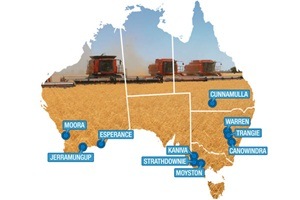
The picture above (from their website) is showing the "purchase of 40,000ha at Telopea Downs, in far western Victoria is close to the final piece of the land purchasing puzzle for Hassad Australia, who’s parent company Hassad Foods is owned by the Qatar Government."


The explanation from Hassad Foods? :“The properties are spread over a wide geographic area, so we limit our exposure to production risk – we don’t want to be too exposed in any one area for climate, disease and other risk reasons.”

This is occurring everywhere and one really interesting thing is that Australia is both land grabbing as well as having its land grabbed, as seen here with Hassad Foods (Qatar). Why do you think this is? From a common sense standpoint, doesn't this all seem pointless, that is, grabbing land from each other instead using land in your country for your country? I think the obvious answer is yes, it is pointless. It really speaks to the other aspect of land grabbing. Other than securing food, we're seeing the private sector, financial aspect come into play here saying there's profit to be made.

Any other thoughts about land grabbing? From "Seized!"? In general? What's land grabbing's relationship with structural violence? 


"GRAIN, a leading international non-profit organisation that works to support small farmers and social movements in their struggles for community-controlled and biodiversity-based food systems".
--FARMLANDGRAB.ORG

Tuesday, May 1, 2012

Black Gold

10 minute clip from the film we partly watched in class, Black Gold. This clip exposes the WTO talks and the lack of involvement, or possibility of involvement, of the Ethiopian coffee growers. (We didn't see this far into the film in class.) Although you can't watch the entire film, more information can be found at the PBS website, such as tracking the coffee you drink/where it comes from. You can watch the whole documentary in 8 parts on YouTube. The film's website: http://blackgoldmovie.com/
The consumers can bring a change if awareness is given to consumers to ask for more fair trade products. TADESSE MESKELA
What are your thoughts on this clip? About the WTO trade talks? Did it seem like another example of a "regime of truth", or truth dualisms, but in a modern international economic light? Discuss!!


Ethiopia is known to be the birth place of Coffee. The name "coffee" is actually derived from a name of a place called "Keffa" which is located in the south western Ethiopia. Coffee is indigenous plant to this area.


UPDATE: The film was released in 2006, you can visit their website here to see the impacts of this documentary on Ethiopian coffee farmers.